
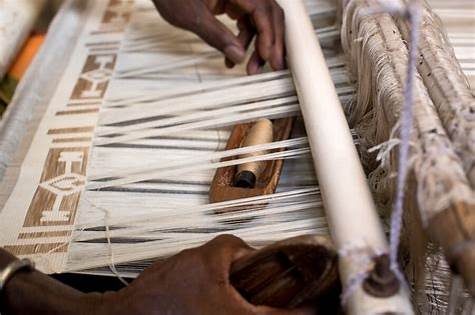
The noise is rhythmic, abrupt, almost mechanical. At times deafening, yet strangely soothing once the ear grows accustomed. The looms rattle, their nacelles clattering in unison, while the weavers exchange a few words in their native Creole, voices weaving through the cadence of the threads.
We are in a shaded alley behind the Gaspard Kamara hospital. Here, these master artisans have found refuge, after being evicted from the land where their craft had long taken root.
Winnis has been working for my grandmother for many years. Like his fellow Bissau-Guineans, he came to Senegal to live from this art—a tradition slowly fading from our local heritage. He learned the trade from his father, and now passes it on to young apprentices, ensuring the thread of knowledge does not break.
The yarns they handle today, imported from China or India, once came from local cotton fields. With skill and patience, they transform them into intricate geometric patterns, shimmering with color.
In Senegal, the woven loincloth carries profound symbolic weight. It cradles the newborn in the arms of his paternal aunt at baptism, veils the young bride as she enters her husband’s home, and accompanies the Muslim deceased to his final resting place—his last possession to be striped off of him.
For these reasons, women—especially mothers—always keep a few loincloths in reserve, ready for life’s milestones, whether joyous or solemn.
My grandmother, Fatou Sow (So’ Fatoo), has been at the heart of this tradition since 1954. As a student, she sold her mother’s woven loincloths to classmates. Later, as her mother aged, she installed a loom in the family courtyard to occupy her days. But when the elder Fary lost interest, my grandmother took over completely, devoting her free time to the craft alongside her duties as director of a secretarial school.
Her innovative patterns and carefully chosen colors soon earned her loincloths a reputation for excellence. She even established a tontine of woven cloths—a collective system that has endured through the years and that she still manages today, at the age of 87.
I grew up in that same courtyard in Liberty 5, under the shade of the sapodilla tree, running among the weavers. Today, in that very place—Villa Keur Fary—our sewing workshop continues the story, producing for the brand SOW FATOU. It is a legacy of authenticity and tradition, one we are determined to carry forward across generations.